Line Shopping for UFC Bets: Why Two UK Books Beat One
 Available in US
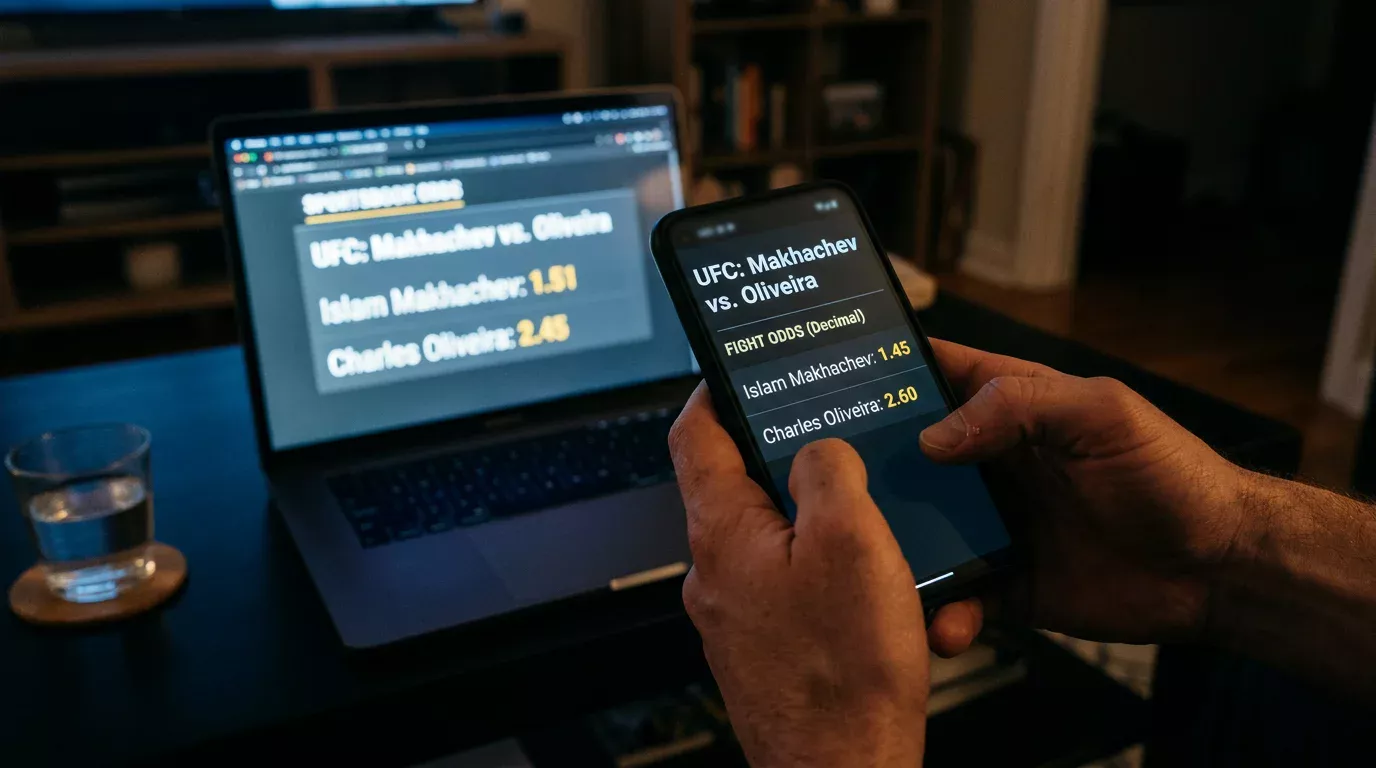
A difference of 0.10 on a decimal price looks like nothing until you compound it across a hundred bets. On a £20 stake, 0.10 is £2. Over a fifty-card year at three bets per card, that is £300 left on the table — not because your analysis was wrong but because you placed the bet at the second-best price. The UK sports betting market generates roughly £2.48 billion in annual gross gaming yield, and a measurable slice of that revenue comes from bettors who never check a second screen before confirming a slip. Line shopping is the simplest edge in MMA wagering, and it requires nothing more than an extra browser tab.
Why Prices Differ Across UK Bookmakers
Two UKGC-licensed sportsbooks can look at the same UFC main event and post different numbers, and neither is wrong. Each operator builds its own margin model, manages its own liability, and reacts to its own customer flow. A bookmaker whose customer base leans heavily towards casual fans will often shade the favourite shorter because that is where the money lands. A rival with a sharper clientele might hold the favourite at a truer price while widening the underdog slightly to protect against informed action.
Market timing amplifies the gap. Operators who release lines early on a Monday after a card announcement carry more uncertainty risk and tend to build wider margins. Those who wait until Thursday, after the weigh-in window narrows the information gap, price tighter but lose the first-mover advantage with early bettors. Neither strategy is inherently better, but both create price discrepancies you can exploit.
Sponsorship and partnership dynamics also play a role. Since bet365 replaced DraftKings as the official UFC betting partner in March 2026, the partnership gives bet365 prominent in-broadcast placement and exclusive data feeds. Whether that translates to consistently sharper pricing is debatable, but it does mean bet365 tends to be among the first to post UFC lines, and early lines are often where the widest margins live.
Regional liability is another driver. A bookmaker with a large Scottish customer base might see heavier action on a Scottish fighter and adjust that specific line while leaving the rest of the card unchanged. That adjustment creates a price gap for anyone checking from outside that betting pool. The UK market is unified by regulation but fragmented by customer demographics, and that fragmentation is what makes shopping viable.
Quantifying the Shopping Edge
The arithmetic is unglamorous but powerful. Suppose you estimate a fighter’s fair probability at 45%, giving a no-margin decimal price of 2.22. Book A offers 2.15 and Book B offers 2.25. At Book A, you are paying an implied probability of 46.5% — above your estimate. At Book B, you are paying 44.4%, which sits below your fair line. The same fight, the same fighter, but one bet has positive expected value and the other does not.
Over a large sample, the cumulative impact is significant. Academic studies on football betting have shown that consistent line shopping can add between 2% and 5% to long-term ROI. MMA markets tend to be less liquid than football, which means the price gaps are often wider. I have logged instances where a UFC moneyline differed by 0.20 or more between two major UK operators on a prelim fight that attracted thin early action.
The effect compounds on accumulator and parlay tickets. If you shop each leg individually and lock in the best available price, the multiplicative gains across four or five legs can turn a marginal accumulator into a meaningfully better-priced one. This is where the ten-minute investment in checking three screens before building a card-wide multi pays its highest dividends.
One caveat: shopping only helps if your underlying analysis is sound. The best price on a bad bet is still a bad bet. Shopping does not create edge; it preserves it. Think of it as the last step in a process that starts with fight analysis, moves through value identification, and finishes with execution at the best available number.
Holding Multiple UK Accounts
There is nothing in UK gambling law that prevents you from holding funded accounts at several UKGC-licensed bookmakers simultaneously. Each account requires its own identity verification, its own deposit, and its own compliance with that operator’s terms, but the act of maintaining three, five, or even ten accounts is perfectly legal and, frankly, standard practice among serious bettors.
The practical minimum for effective line shopping is three accounts. Two gives you a comparison; three gives you a market. I keep active balances at five UK books for MMA, which covers the full spectrum from the largest exchange-style platforms to mid-tier sportsbooks that occasionally post outlier prices on undercard fights.
As Trip Stoddard, Head of Development at bet365, put it when announcing the UFC partnership, the appeal of combat sports lies in the always-on event calendar and a fanbase that engages in real time. That engagement is precisely what creates price diversity — different bookmakers see different patterns of real-time action, and those patterns produce different prices. Multiple accounts let you sit on the right side of that diversity rather than accepting whatever one operator decides to post.
Account management does require discipline. Each bookmaker has its own bonus terms, its own withdrawal process, and its own approach to restricting successful bettors. Keeping a simple spreadsheet of account balances, pending withdrawals, and any active promotional requirements prevents the kind of administrative confusion that turns a shopping advantage into an accounting headache.
Using Odds Comparison Tools
Manual comparison across five bookmaker tabs is viable for a single fight but impractical across a twelve-bout card. Odds comparison sites aggregate prices from multiple UK operators and display them in a sortable grid, updated in near real time. For UFC events, the most useful comparators refresh within a few minutes of line changes, which is fast enough for pre-match shopping though not always reliable for in-play windows.
The key metric to look for on any comparison tool is the overround — the total implied probability across all outcomes in a market. A two-way UFC moneyline market with a combined overround of 105% carries a 5% margin. If one bookmaker posts 106% and another 104%, the latter is offering a structurally fairer market. Some comparison sites display overround directly; others require you to calculate it from the listed prices.
One limitation worth noting: comparison tools track headline prices but not always the maximum stake available at that price. A bookmaker might show the best UFC underdog price on a comparison site but limit your actual wager to £10 at that number. If you are staking in units of £50 or above, the displayed best price might not be fully accessible. Always verify the stake limit on the bookmaker’s own platform before assuming the comparison site tells the whole story.
A Practical Shopping Workflow
My routine for a standard UFC card looks like this. On Monday or Tuesday, once the full card is confirmed, I open lines at three core bookmakers and note the prices on any fights I have already researched. I do not bet yet — I am mapping the landscape. By Wednesday, a fourth and sometimes fifth operator will have posted lines, and I update my notes. Thursday after the pre-fight press conference, I check for any movement driven by news, trash talk, or injury hints.
Friday is the action day. After weigh-ins — usually streamed in the early evening UK time — I do one final sweep across all accounts. If a price I want has moved against me at one book but held at another, I place at the book where it held. If the best price sits at a bookmaker where I have a pending promotional requirement, I check whether the bet qualifies before confirming.
The entire process takes about fifteen minutes per card day, spread across three or four short sessions. Across a year with roughly fifty UFC events, that is around twelve hours of total work for what could easily be a 3-5% improvement in long-term returns. No other single behaviour change in MMA betting delivers that ratio of effort to outcome.
Is holding multiple UK betting accounts allowed?
Yes. UK gambling law does not restrict how many UKGC-licensed accounts you hold. Each operator sets its own terms, and each requires separate identity verification and deposits, but maintaining accounts at several bookmakers is legal and common among bettors who shop for the best price.
How big does the price difference need to be before it matters?
Any difference matters over a large enough sample, but as a practical threshold, a gap of 0.05 or more on decimal odds is worth acting on for standard unit stakes. On a £25 bet, 0.05 equates to £1.25 per bet. Across 150 bets a year, that is nearly £190 — enough to fund several additional wagers entirely from the shopping edge alone.
Published by the mma Betting Websites team.