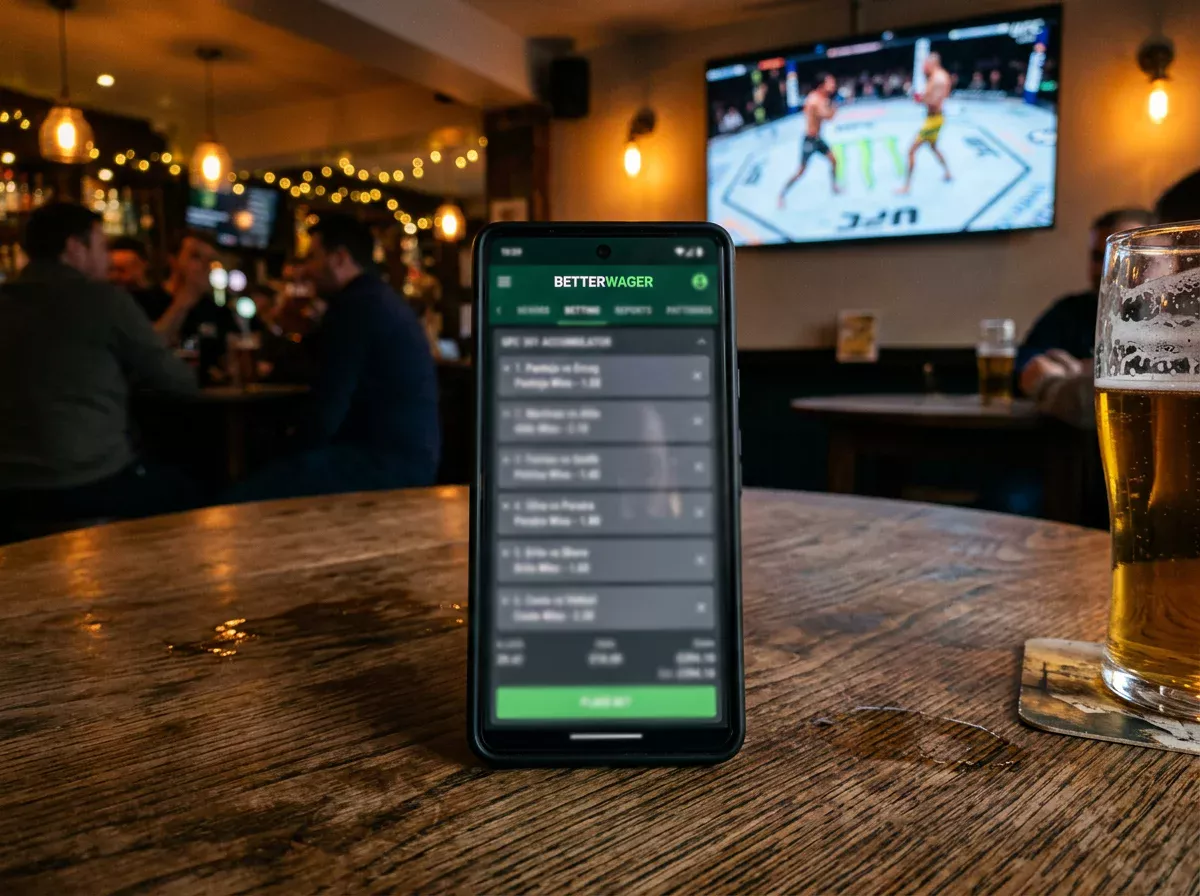
Reading UFC Odds Movement: Sharp Money, Public Money, and Steam Moves
 Available in US
Every UFC line tells two stories. The first is the bookmaker’s opening assessment of a fight. The second is how the market responds — where money lands, when it lands, and how much of it arrives at once. Learning to read that second story separates bettors who react to prices from those who understand what prices are reacting to. Movement is not noise. It is information flowing through the market in real time, and decoding it correctly is one of the most underused skills in MMA handicapping.
Opening Lines and the Road to Close
A UFC opening line appears anywhere from ten days to one week before the event, depending on the operator. At this stage, the bookmaker is working primarily from internal models: historical fighter data, recent form, divisional averages, and stylistic projections. The margin is typically at its widest because the book has had no customer flow to calibrate against.
Between the opener and the closer — the final price at the moment the cage door shuts — the line absorbs every meaningful input. Injury reports, training camp footage, weigh-in results, social media chatter, and of course the bets themselves all get priced in. The closing line is the market’s consensus, refined by thousands of individual transactions, and it is consistently the most accurate predictor of fight outcomes available to anyone without inside information.
For bettors, the distance between the opening and closing line is the map. If a fighter opens at 2.50 and closes at 2.20, money has pushed them from moderate underdog territory toward near-coin-flip range. Whether that movement is sharp or public, organic or artificial, fast or gradual — those distinctions determine whether the move is a signal or a trap.
Steam Moves and What They Signal
A steam move is a sudden, significant price shift triggered by a large volume of money arriving at multiple bookmakers within a short window. The hallmark is speed: a fighter might move from 2.80 to 2.40 across three operators in under ninety minutes, with no public news to explain the shift. These moves are the market’s version of an alarm bell, and they almost always originate from a small group of sharp bettors acting on information or analysis that the broader market has not yet absorbed.
The mechanics are straightforward. A well-funded bettor places a substantial wager at one bookmaker, which adjusts its line. That adjustment is visible to odds comparison feeds, and other sharp bettors — or automated systems — then hit the stale price at a second operator before it adjusts. The cascade continues until every major book has moved. The entire process can take less than an hour.
Not every rapid move is a steam move. Line corrections after a weigh-in cancellation, a late injury announcement, or a fighter swap can look similar in speed but differ in origin. A true steam move has no accompanying news event. The price moves because someone with capital and conviction has taken a position, and the market is recalibrating around that conviction.
For the average UK bettor, the takeaway is timing. If you have already identified a value position on the same side as a steam move, confirming your bet quickly preserves the price. If the steam is running against your position, the move does not automatically invalidate your analysis, but it should prompt a second look at your assumptions. Sharp money is not infallible, but it is right often enough to demand attention.
Public Bias in MMA Markets
Public money behaves differently from sharp money. It arrives later in the week, clusters around familiar names, and flows disproportionately toward favourites and fighters with large social media followings. UFC estimates its global fanbase at around 700 million people, and the portion of that audience who bet casually tend to gravitate toward the fighters they have seen on broadcast rather than the fighters whose stylistic profile offers the best matchup value.
The signature of public money is a slow, steady drift in one direction. A champion opening at 1.45 might grind down to 1.35 over four days as casual bettors stack money on the name they recognise. The underdog’s price inflates correspondingly, from 2.90 to 3.10 or higher. This inflation is where contrarian bettors find their edge — not by blindly fading favourites, but by identifying spots where public money has pushed the underdog’s price above its fair level.
One useful filter: compare the direction of money with the direction of the line. If 70% of bets are on Fighter A but the line is moving toward Fighter B, the implication is that the 30% on Fighter B represents a larger total stake — in other words, sharper, higher-value wagers. This is called reverse line movement, and in MMA markets where liquidity is thinner than in football or basketball, it stands out clearly to anyone watching the numbers.
Injury and News-Driven Movements
Not all line movement comes from betting flow. The most dramatic shifts in UFC pricing follow news events that change the fundamental conditions of a fight. A fighter withdrawing with an injury and being replaced by a short-notice opponent can swing a line by a full point or more on the decimal scale. A missed weight at Friday’s weigh-in routinely moves prices by 0.15 to 0.30 in the hours that follow.
The most extreme recent example was the Johnson versus Hernandez bout at UFC 324 in January 2026. Anomalous betting activity triggered a 234-point line shift, and the fight was ultimately pulled from the card hours before it was due to start. That kind of movement — massive, sudden, and concentrated on a single bout while the rest of the card holds steady — is a structural red flag that goes beyond normal market dynamics.
For UK bettors, the practical lesson is to separate news-driven moves from opinion-driven moves. A price shift that follows a public injury report or a weigh-in miss is the market correctly repricing known information. A price shift that precedes any public information is the market telling you something that you — and most other bettors — do not yet know. The former is an opportunity to reassess. The latter is a warning to pause.
Turning Movement into a Usable Signal
Reading line movement is not the same as acting on it, and this is where most bettors go wrong. Chasing steam after the price has already corrected means buying a stale edge. Fading public money without understanding why the public is wrong means betting against the crowd for its own sake. Neither approach works in isolation.
Movement data becomes genuinely useful when it intersects with your own analysis. If you have spent Tuesday evening breaking down a stylistic matchup and concluded that Fighter B has a 48% chance of winning, and by Thursday a steam move has pushed Fighter B’s price from 2.80 to 2.40 — confirming the direction of your analysis — you now have convergence between your model and the market’s revealed preferences. That convergence strengthens conviction, even if the window to bet at the best price has narrowed.
Conversely, if your model says Fighter B at 48% and the line is moving the other way, extending to 3.20, the divergence does not necessarily mean you are wrong. It might mean public money is inflating the price in your favour, giving you an even better entry. The key is knowing whether the movement is driven by informed capital or uninformed volume, and the timing and speed clues described above are the primary tools for making that distinction.
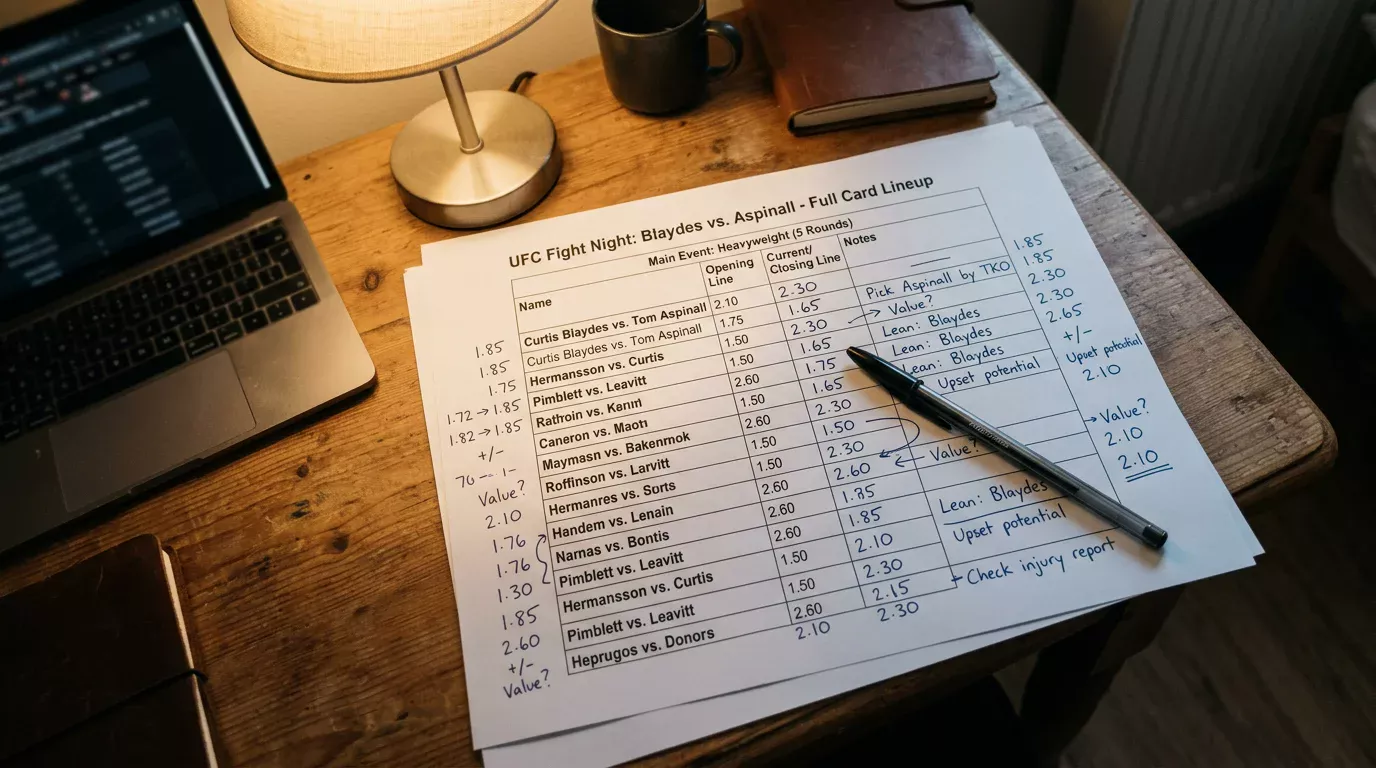
I keep a simple log for every UFC card: opening line, line at Wednesday close, line at weigh-in, and closing line. Over time, patterns emerge — certain bookmakers move first on sharp action, certain weight classes attract heavier public bias, certain card positions (early prelims versus main card) show wider discrepancies between opening and closing prices. That log, reviewed quarterly, has done more for my value identification process than any single analytical framework.
What is a steam move on a UFC fight line?
A steam move is a rapid, significant price shift across multiple bookmakers within a short period, typically driven by a concentrated burst of sharp money. It happens without an accompanying news event and usually completes within sixty to ninety minutes. Steam moves indicate that well-informed bettors have identified a position and are acting aggressively enough to move the market.
How big a UFC line move signals sharp action?
A shift of 0.15 or more on the decimal scale within a few hours, without a public news catalyst, is a strong indicator of sharp action. Moves of 0.30 or above in a single session are rare and almost always represent institutional-level conviction. Context matters — the same 0.15 move on a thin prelim market is more significant than on a main-event line with deep liquidity.
Created by the ”mma Betting Websites” editorial team.