Live and In-Play UFC Betting in the UK: How the Octagon Markets Move Round-by-Round
 Available in US
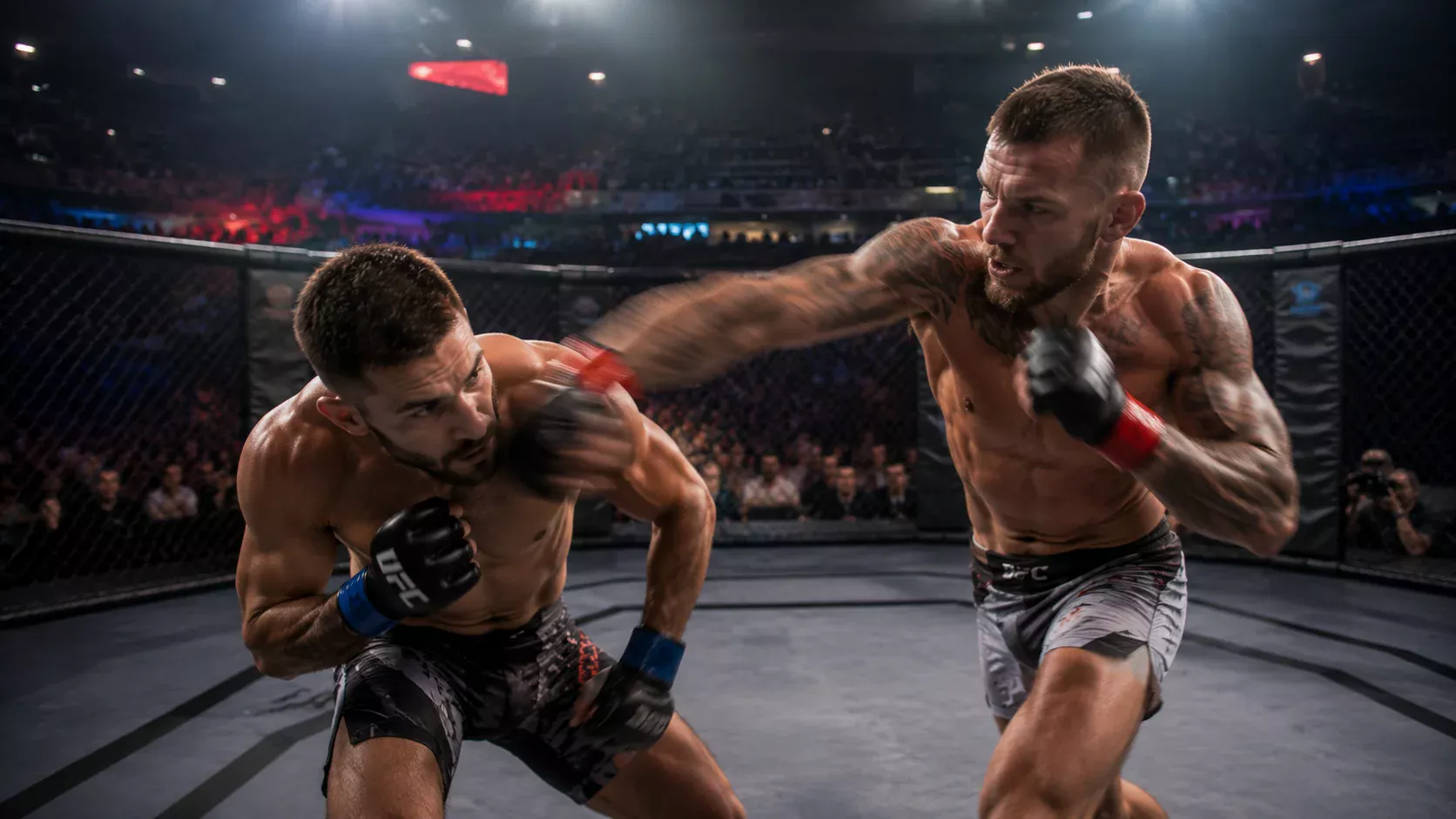
In-play UFC betting is not the same product with a “live” badge slapped on it. It is a separate micro-market with its own rhythm — odds suspended during exchanges, lines recalculated in the ten-second pauses between flurries, and a 60-second between-round window that functions as the most concentrated trading floor in sports betting. I have watched a moneyline flip from 1.35 to 3.50 in the time it takes a corner to wipe blood off a fighter’s face. If you treat live UFC the way you treat pre-match, you will haemorrhage money.
Trip Stoddard, bet365’s Head of Development, described the UFC’s appeal for real-time wagering when announcing the company’s new partnership: the “always-on event calendar and highly engaged global fanbase create a powerful environment for real-time betting.” That environment is powerful, but it is also unforgiving if you do not understand the mechanics underneath the surface.
How In-Play UFC Works
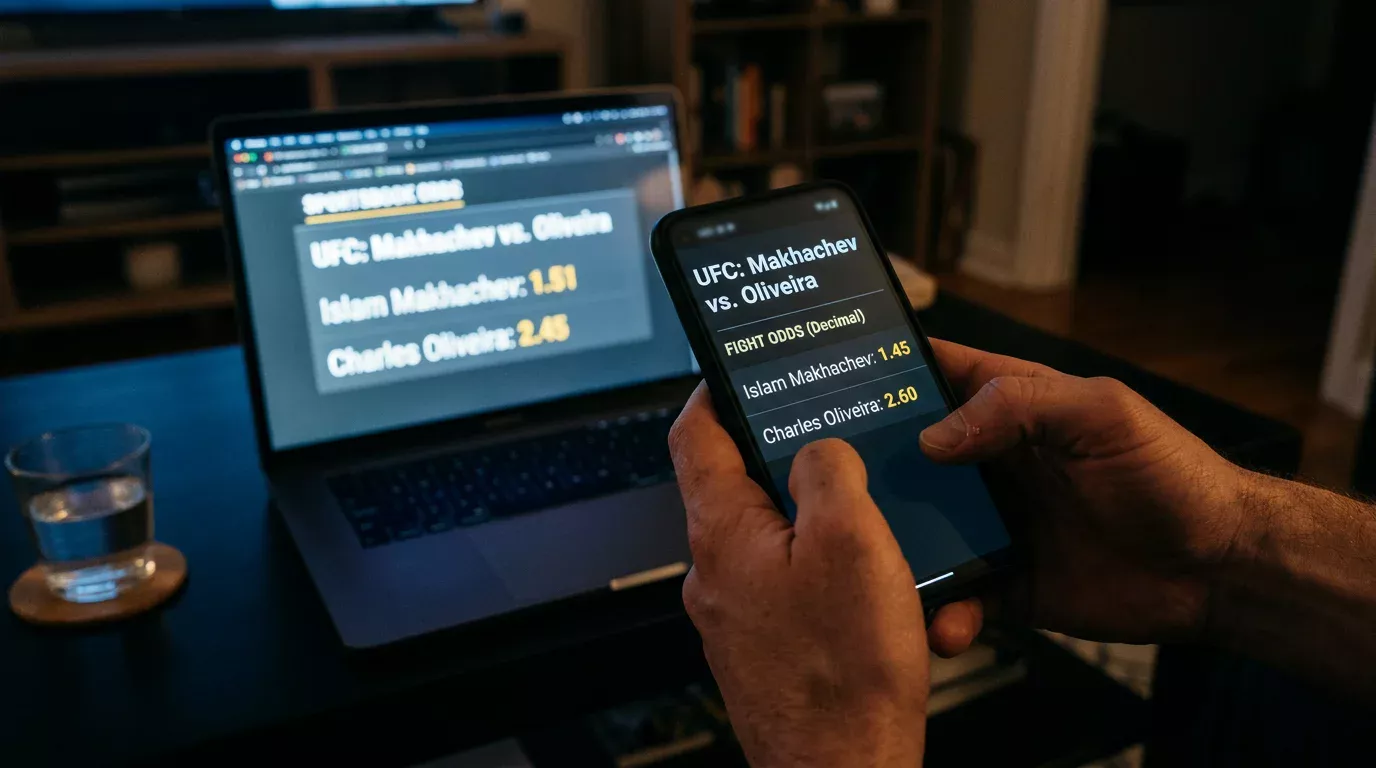
I remember the first time I tried to place a live UFC bet mid-round. I clicked on a moneyline at 1.80, and by the time the bet slip loaded, the odds had moved to 2.10 because the fighter I was backing had just eaten a clean right hand. The bet was rejected. That is in-play MMA in one interaction — the market moves faster than the interface.
The basic mechanic: once a fight begins, the bookmaker switches from pre-match to in-play mode. The moneyline and, on some platforms, method of victory and over/under markets remain available, but the prices update continuously based on what is happening in the octagon. A takedown shifts the line. A visible cut shifts it further. A knockdown can move the odds by a full point in seconds.
Unlike football, where a goal is a discrete event and the market adjusts around it, MMA action is continuous and ambiguous. A fighter landing three clean jabs might look dominant on screen but mean little statistically. A fighter pressing against the cage for two minutes might be winning on the scorecards but losing the visual battle. The bookmaker’s algorithms interpret these moments using a combination of live data feeds and pre-built models, and those interpretations drive the prices you see.
In-play markets are typically more limited than pre-match. You will usually get moneyline, over/under, and sometimes method of victory. Exact-round betting, props, and Bet Builder are rarely available live. The reason is straightforward: the bookmaker cannot price correlated multi-leg markets accurately when the underlying probabilities are shifting every few seconds. They stick to the markets they can model in near-real-time and close everything else.
One detail worth flagging early: the odds you see on screen during a live fight are not necessarily the odds you will get when your bet is accepted. Most UK operators use a “price at acceptance” model for in-play markets, meaning the confirmed price is whatever the algorithm is offering at the exact moment the server processes your bet, not the price displayed when you tapped. Some platforms let you set an acceptable range — “accept odds within 0.10 of the displayed price” — but the default is usually to reject the bet if the price has moved beyond a threshold. This is one of the reasons mid-round betting feels so unreliable: by the time your input reaches the server, the fight may have moved on.
Between-Round Markets
The 60-second break between rounds is the single most important window in live UFC betting. It is the only moment where the market stabilises, the bookmaker reopens suspended lines, and you can place a bet without the odds moving under your finger while you tap.
During a round, the odds shift in real-time but are frequently suspended during scrambles, clinch exchanges, knockdowns, and any moment where the fight’s trajectory is too uncertain to price. Between rounds, the book absorbs all the information from the previous round — scorecards, damage, fighter movement, corner instructions — and resets the line. This between-round price is the closest thing to a “fair” in-play line you will see, because it reflects a settled assessment rather than a reactive one.
The tactical approach I use: I watch the fight without betting during the round, form my view on what just happened and how it changes the outlook, and then act in the between-round window. That approach sacrifices the potential upside of catching a mid-round price swing — like backing a fighter at 3.50 after they got wobbled but before they recovered — but it eliminates the mechanical risk of suspended bets, rejected slips, and odds that change between tap and confirmation.
Between-round markets also offer a view on how the bookmaker scores the fight. If the favourite won Round 1 on your scorecard but the between-round odds barely moved, the book either disagrees with your scoring or had already priced that round in her favour. If the odds shifted significantly toward her, the book aligns with your assessment. That feedback loop — your scorecard versus the market’s — is the fastest way to calibrate your live fight-reading against what the money actually says.
Live Method of Victory Shifts
Pre-match, you might have a fighter’s KO/TKO method priced at 2.80 and submission at 6.00. Two rounds into the fight, those numbers can invert completely. If the striker is getting taken down repeatedly, the submission price collapses while the KO price extends. If the grappler is getting tagged standing up, the opposite happens. Live method of victory is a real-time referendum on how the fight is actually playing out versus how it was expected to play out.
The most dramatic shifts happen when a fighter reveals a vulnerability that was not visible in the pre-fight analysis. A wrestler who suddenly cannot defend a single takedown. A striker whose chin looks compromised after an early shot. These are informational gifts — the fight is telling you something the pre-match market could not have known, and the live method prices adjust to reflect it.
There is a catch, though. Live method of victory markets are not always available, and when they are, the margin is wider than pre-match. The bookmaker knows that bettors acting on live method of victory tend to have better information (they are watching the fight) and charges accordingly. You are paying a premium for the privilege of acting on what you can see, which means the edge needs to be substantial enough to overcome the higher tax.
I tend to use live method of victory in one specific scenario: when a fight has clearly shifted to a grappling battle but the submission price has not moved as fast as the ground control time suggests it should. Grapplers who secure dominant positions early in a round often get the finish in the second half of that round, and the market sometimes lags by ten or fifteen seconds in adjusting the submission price. It is a narrow window, but it is real.
Cash Out Mechanics
Cash out on a live UFC bet is the bookmaker offering to buy your position back before the fight ends. The offer changes constantly during the bout, and it is always priced with a margin in the bookmaker’s favour. If your fighter is winning after two rounds and your pre-match moneyline bet is sitting in profit, the cash-out offer will reflect that — but it will be less than the full implied value of your position.
The mechanics: you open your bet slip or active bets section, and if cash out is available on your wager, a green button shows the current offer. That number updates in real-time. During a round, the offer might fluctuate every few seconds. Between rounds, it stabilises briefly. Partial cash out is available on some platforms — you can cash out a portion of your stake and let the rest ride, which splits your position into a guaranteed profit component and a remaining risk component.
UFC GGR growing at a compound annual rate above 18% has incentivised operators to build better cash-out infrastructure specifically for combat sports, because it keeps money cycling through the system. A bettor who cashes out before a fight ends has liquidity to bet on the next fight. The bookmaker gets the margin on the cash-out price and gets the customer back in the market sooner.
My own relationship with cash out is disciplined to the point of boring. I use it only when the fight has changed in a way my pre-match analysis did not anticipate — an injury, a style mismatch that only became visible mid-fight, a fighter who looks physically compromised. If the fight is unfolding roughly as expected, I let the bet run. Cash out is a hedge, not a strategy, and treating it as a regular exit costs more in margin than it saves in risk. Understanding the full hierarchy of UFC bet types helps clarify when cash out adds value and when it merely adds cost. For a deeper look at when accepting the offer makes mathematical sense, the cash out guide breaks down the pricing model in detail.
Live Streaming Integration
Watching and betting on the same screen sounds seamless until you realise the stream is delayed by anywhere from five to thirty seconds relative to the live broadcast. That lag is the gap between what has already happened in the octagon and what you are seeing on your bookmaker’s stream, and it cuts both ways.
When bet365 became the UFC’s official betting partner in March 2026, Nicholas Smith, TKO’s SVP of Global Partnerships, described the integration as providing fans with “deeper insights, dynamic odds, and more ways to engage responsibly with every bout, from the opening bell to the final decision.” The streaming integration is a core part of that value proposition — the idea that you can watch the fight and act on what you see within the same interface.
In practice, the integration works better for between-round decisions than for mid-round reactions. If you are trying to place a live bet on a knockdown you just watched happen on the bookmaker’s stream, the market has already moved — because the bookmaker’s pricing feed runs ahead of the customer-facing stream. The odds you see have already absorbed the knockdown before your stream showed it to you. This is not a flaw in the system; it is how the system is designed. The bookmaker prices from a real-time data feed, not from the same delayed stream they serve to customers.
Not every UK-licensed bookmaker streams UFC. The availability depends on broadcast rights, which in the UK sit with TNT Sports for numbered pay-per-view events and with various platforms for Fight Night cards. Some operators stream prelims but not the main card. Others require a funded account with a minimum balance to access the stream. If live streaming is central to your in-play approach, check which events your bookmaker actually covers before fight week, not after the main event has started.
Latency and Bet Suspension
Every live UFC bettor has experienced the “greyed out” button. You see an opportunity, you tap the odds, and the market suspends before your bet is accepted. It happens because the bookmaker’s system detects a high-volatility moment — a knockdown, a submission attempt, a referee intervention — and freezes the market until the situation resolves.
Suspension triggers in UFC are more frequent than in any other sport I bet on. A football match might suspend on a goal, a penalty, and a red card — three or four times in 90 minutes. A UFC fight can suspend dozens of times in 15 minutes. Every significant strike that rocks a fighter, every takedown that changes position, every clinch break that leads to a scramble can trigger a suspension. The bookmaker’s system errs on the side of closing the market rather than offering a stale price, because a stale price in a fast-moving MMA fight is a guaranteed loss for the book.
The practical impact: you cannot reliably place bets during the most dramatic moments of a fight. The moments when the odds move the most are exactly the moments when the market is closed. This is by design, and there is no way around it. Anyone selling a “live UFC betting system” that relies on catching mid-action price swings is selling fiction.
What you can do is prepare your bets in advance. Before the fight starts, identify the scenarios that would make you want to bet live. “If the wrestler gets taken down in Round 1, I will back the grappler on method of victory at the between-round break.” “If this fight reaches Round 3, I will take the over on distance.” Pre-planning removes the reactive element and turns the between-round window into an execution moment rather than a decision moment. That distinction — thinking before the bell, acting between the rounds — is the single biggest edge in live UFC betting.
Live Betting Limits in the UK
UK bookmakers set lower maximum stakes on live UFC markets than on pre-match, and the difference is significant. A pre-match moneyline on a main event might accept stakes up to several hundred pounds depending on the operator. The same moneyline in-play might cap at 50 or 100 pounds, and on undercard fights, the limit can drop to 10 or 20.
The logic is simple. In-play bettors have more information than pre-match bettors — they are watching the fight — and the bookmaker limits its exposure to that informational advantage by capping how much money it accepts per bet. If you are consistently profitable on live UFC wagers, your limits may tighten further over time as the bookmaker’s risk system identifies you as a sharp customer.
Online real-event betting GGY in the UK fell 18% to 530 million pounds in the October-to-December 2025 quarter, a reminder that the live betting market is not infinitely expandable and that operators manage their exposure carefully during periods of uncertainty. For MMA bettors, this translates into a practical constraint: you cannot deploy large sums on live UFC markets the way you might on a Premier League match. Your staking needs to fit within the available limits, which means live UFC is better suited to smaller, high-conviction bets than to volume plays.
One workaround that experienced bettors use: split the same bet across multiple operators. If your live stake is 100 pounds and one bookmaker caps you at 30, you can place 30 at one book and 70 at another, assuming both offer similar odds. This is legal, normal, and one of the reasons holding multiple UK accounts is standard practice rather than an edge case.
Live Bankroll Discipline
Live UFC betting is addictive in a way that pre-match betting is not. The fight is happening, the odds are moving, the screen is flashing, and every knockdown feels like a signal to act. I know this because I have been there, and the first six months of my live betting career were a net loss specifically because I could not stop pressing buttons.
The discipline framework I eventually settled on has three rules. First, set a live budget per card that is separate from your pre-match budget. I allocate no more than 20% of my card-level bankroll to live plays. If I have committed 50 pounds to a UFC card, no more than 10 of those pounds go to in-play wagers. Second, limit the number of live bets per event. Three is my ceiling. If I have not found a live opportunity worth taking in three bets, the card is not producing the right conditions and I stop. Third, never chase a pre-match loss with a live bet. If your pre-match moneyline loses, the temptation to “make it back” during the next fight is overwhelming and almost always unprofitable.
The emotional component is the hardest part to manage. Watching a fight live creates urgency that does not exist in pre-match analysis. You feel like you need to act now because the opportunity will disappear. Sometimes that is true. More often, the urgency is manufactured by adrenaline, and the “opportunity” is a market priced correctly that you are convincing yourself is mispriced because the fight is exciting. Excitement is not edge. If you cannot articulate why the live price is wrong in one sentence before you place the bet, do not place it.
The Round Between Rounds
Live UFC betting is a specialist discipline within a specialist sport. The core mechanics — continuous odds adjustment, frequent suspensions, between-round windows, stream latency, and lower stake limits — make it fundamentally different from pre-match wagering. The bettors who profit from live MMA are not the ones with the fastest fingers. They are the ones who did the pre-fight work, identified the scenarios worth acting on, and then waited for the between-round window to execute. The fight happens in the octagon. The edge happens in the preparation.
Why does in-play UFC betting suspend during knockdowns?
The bookmaker’s system detects high-volatility moments — knockdowns, submission attempts, referee interventions — and suspends the market to avoid offering stale prices. MMA action is continuous and can change the fight’s trajectory in seconds, making mid-action pricing unreliable. The market reopens once the situation stabilises or between rounds.
Can I watch UFC live streams on UK betting sites?
Some UK-licensed bookmakers stream UFC events, but availability depends on broadcast rights and event type. Prelims are more commonly streamed than main cards. Most operators require a funded account or a minimum balance to access the stream. Check your bookmaker’s coverage before fight week.
Why does cash out get suspended during a UFC round?
Cash out relies on the same real-time pricing model as the in-play market. When the market suspends during a knockdown or submission attempt, the cash-out offer also pauses because the bookmaker cannot price your position accurately until the action settles. Cash out typically reactivates between rounds.
Why do live UFC odds lag the broadcast feed?
The customer-facing stream on a betting site runs five to thirty seconds behind the real-time broadcast. The bookmaker’s pricing feed, however, runs on near-real-time data. This means the odds you see have already absorbed events that your stream has not yet shown you. The lag is structural and applies across all operators.
Prepared by the mma Betting Websites editorial staff.