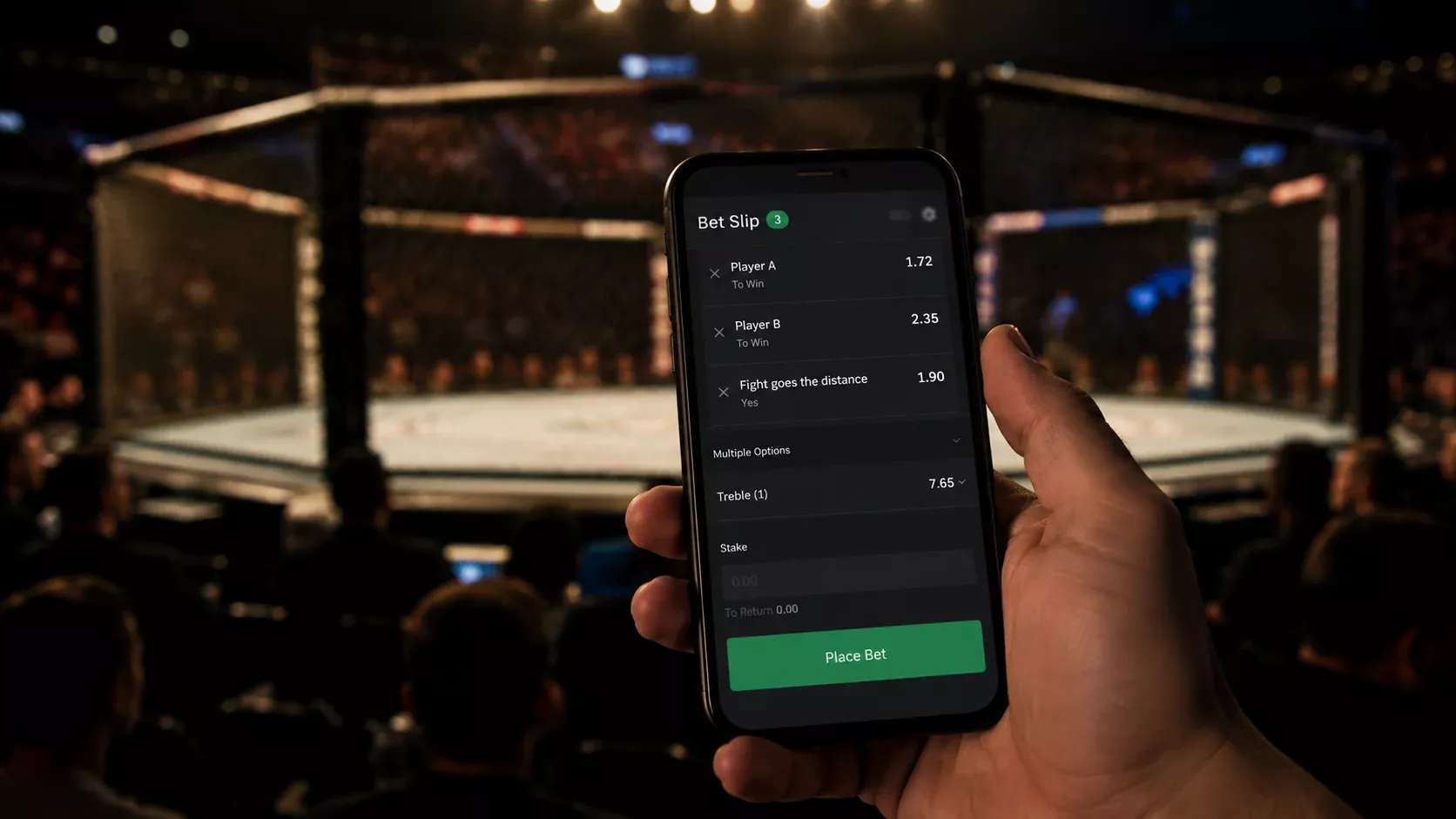
UFC Bet Tracking: A Simple System to Keep Honest Records
 Available in US

Without a written record of every bet you place, you cannot distinguish skill from luck. The fighter you backed at 3.20 who won by knockout in round two feels like brilliant analysis, but was the closing line 2.80 or 3.50? Did you beat the market or chase a stale number? Did your thirty bets last quarter produce a genuine positive ROI or did three lucky underdogs mask a fundamentally losing approach? Bet tracking answers these questions with data instead of memory, and memory — particularly the selective kind that remembers wins and softens losses — is not your friend in this process.
What Fields to Record
A functional bet log needs a minimum of ten fields per entry. Date of the bet. Event name (UFC 305, UFC Fight Night: Smith vs Jones). Fighter or selection backed. Market type (moneyline, over/under, method of victory, prop). Odds at time of placement. Stake in pounds. Closing line — the final price at the moment the cage door shut. Result (win, loss, void, push). Payout or loss amount. And a brief notes field for your reasoning: why you placed this bet, what your estimated probability was, and any contextual factors that influenced the decision.
The notes field is the most neglected and the most valuable. A year from now, when you review a batch of losing bets, the numbers will tell you what happened but the notes will tell you why. “Backed Jones at 2.40 because his TDD looked solid against wrestlers” is a note you can evaluate in hindsight: was the TDD assessment correct? Did Jones face a different type of wrestler than expected? Did the market know something your analysis missed? Without the note, the bet is just a line in a spreadsheet. With the note, it is a learning opportunity.
I also record the bookmaker used for each bet, which feeds into a separate analysis of which operators consistently offer the best prices on the markets I bet. Over a year, patterns emerge — one bookmaker might consistently offer the best UFC underdog prices while another leads on over/under rounds. That data informs my line-shopping workflow and helps me allocate deposits across accounts more efficiently.
Closing Line Value and Edge Tracking
Closing line value (CLV) is the most reliable long-term predictor of betting proficiency. If you consistently bet at prices that are better than the closing line — meaning the market moved in the direction of your bet after you placed it — you are, on average, making decisions that the broader market eventually confirms. Positive CLV does not guarantee profit on any single bet, but across hundreds of bets, a bettor with consistent positive CLV is almost certainly operating with genuine edge.
The number of online MMA betting users grew by 45% in 2022, and the continued expansion of the market means more bettors are competing for the same mispricings. In that environment, tracking CLV is not optional — it is the primary feedback mechanism that tells you whether your analysis is still producing edge or whether the market has caught up to your approach.
To track CLV, you need to record both your placement odds and the closing odds. The CLV for each bet is calculated as: (your odds / closing odds) – 1. If you placed at 2.40 and the line closed at 2.20, your CLV is (2.40 / 2.20) – 1 = +9.1%. If you placed at 2.40 and the line closed at 2.60, your CLV is (2.40 / 2.60) – 1 = -7.7%. Over time, the average CLV across all your bets tells you whether you are beating the market systematically or riding variance.
A consistently negative average CLV, even alongside short-term profits, is a warning sign. It means you are placing bets at prices worse than the market’s consensus, and the profits are likely driven by variance rather than skill. Conversely, a positive average CLV alongside short-term losses is encouraging — the process is sound, and the results should converge given enough sample size.
Monthly and Quarterly Reviews
Raw bet logging is necessary but not sufficient. The value crystallises in periodic reviews where you aggregate the data, calculate performance metrics, and identify patterns. I run a lightweight review at the end of each month and a deeper review at the end of each quarter.
The monthly review covers five metrics: total bets placed, win rate, total profit or loss in pounds, ROI as a percentage of total stakes, and average CLV. These numbers take ten minutes to calculate from a well-maintained log and give you a high-level picture of whether the month was positive, negative, or flat. The monthly cadence is frequent enough to catch emerging problems without overreacting to the small sample sizes that a single UFC card produces.
The quarterly review goes deeper. I segment bets by market type (moneyline, over/under, method, prop), by card tier (early prelims, prelims, main card), by odds range (favourites below 1.80, close fights 1.80 to 2.50, underdogs above 2.50), and by bookmaker. Each segment gets its own ROI and CLV calculation. The segmented view often reveals that overall profitability is being driven by one specific market type or odds range while other segments are losing. That insight redirects attention and capital toward the profitable segments and away from the unprofitable ones.
Spreadsheet vs Dedicated Tracking App
A simple spreadsheet is the right tool for most UFC bettors. A blank sheet with ten columns, one row per bet, and a summary row at the bottom for totals and averages covers the full requirement. The advantages of a spreadsheet are flexibility (you can add columns, build formulas, create charts), portability (cloud-synced sheets are accessible from any device), and ownership (your data stays under your control).
Dedicated bet-tracking apps offer convenience features — automatic odds recording, performance dashboards, built-in CLV calculators — that save time for high-volume bettors. The trade-off is that you are entering your data into someone else’s system, which raises questions about data privacy and long-term access. If the app shuts down or changes its pricing model, your historical records may be difficult to export. For bettors placing five to fifteen UFC bets per month, the spreadsheet’s simplicity outweighs the app’s convenience.
Whichever tool you choose, the non-negotiable requirement is that every bet gets logged before the fight starts. Recording bets after the result creates a bias toward remembering winners and forgetting losers, which corrupts the data set. The discipline of logging pre-fight — entering the date, selection, odds, stake, and reasoning before the first punch is thrown — ensures the record is honest regardless of the outcome.
Using Records to Spot Leaks
A leak is a systematic pattern of negative expected value that shows up in the data but is invisible in real time. Common leaks in MMA betting include: consistently negative CLV on main-event moneylines (suggesting you are betting popular fighters at stale prices), negative ROI on three-round fights but positive on five-round main events (suggesting your analysis works better over longer fights), and negative ROI on props but positive on moneylines (suggesting prop analysis needs improvement or should be abandoned).
With a global fanbase of roughly 700 million people, UFC generates enormous public interest that filters into betting markets as casual money. Bettors who track their records can identify whether their own betting patterns resemble the casual public’s — favouring main-event favourites, chasing parlays on popular names, overweighting recent performance — or whether they have genuinely differentiated their approach. The records do not lie, and the patterns they reveal are the foundation for targeted improvement.
I review my leaks quarterly and set specific goals for the following quarter. If Q1 data showed negative ROI on early-prelim bets, Q2’s goal is either to improve early-prelim analysis by adding regional tape study or to stop betting early prelims entirely. If Q2 data showed positive CLV but negative profit, the goal is to hold discipline and trust the process. The tracking system creates a feedback loop between bankroll management, analytical improvement, and capital allocation that no amount of intuition can replicate.
What’s the minimum set of fields a UFC bet log should record?
Ten fields cover the essentials: date, event name, selection (fighter or market), market type, odds at placement, stake, closing odds, result, payout or loss, and a brief reasoning note. The closing odds field is critical for calculating CLV, and the reasoning note is what transforms the log from a ledger into a learning tool. Additional fields like bookmaker used, card tier, and odds range are useful for segmented performance reviews but are not strictly necessary to get started.
How long before bet tracking produces statistically useful results?
A minimum of 100 to 150 bets across at least six months of activity is needed before the data becomes directionally reliable. Smaller samples are dominated by variance and can mislead in both directions — a lucky streak of twenty bets can show a 15% ROI that collapses over the next hundred. CLV tracking becomes meaningful slightly faster, around 50 to 75 bets, because the metric is less sensitive to outcome variance than raw profit. The key is to start logging immediately and resist drawing firm conclusions until the sample size supports them.
Prepared by the mma Betting Websites editorial staff.