
Decimal vs Fractional Odds on UK MMA Betting Sites: Which Format Suits Which Bet
 Available in US
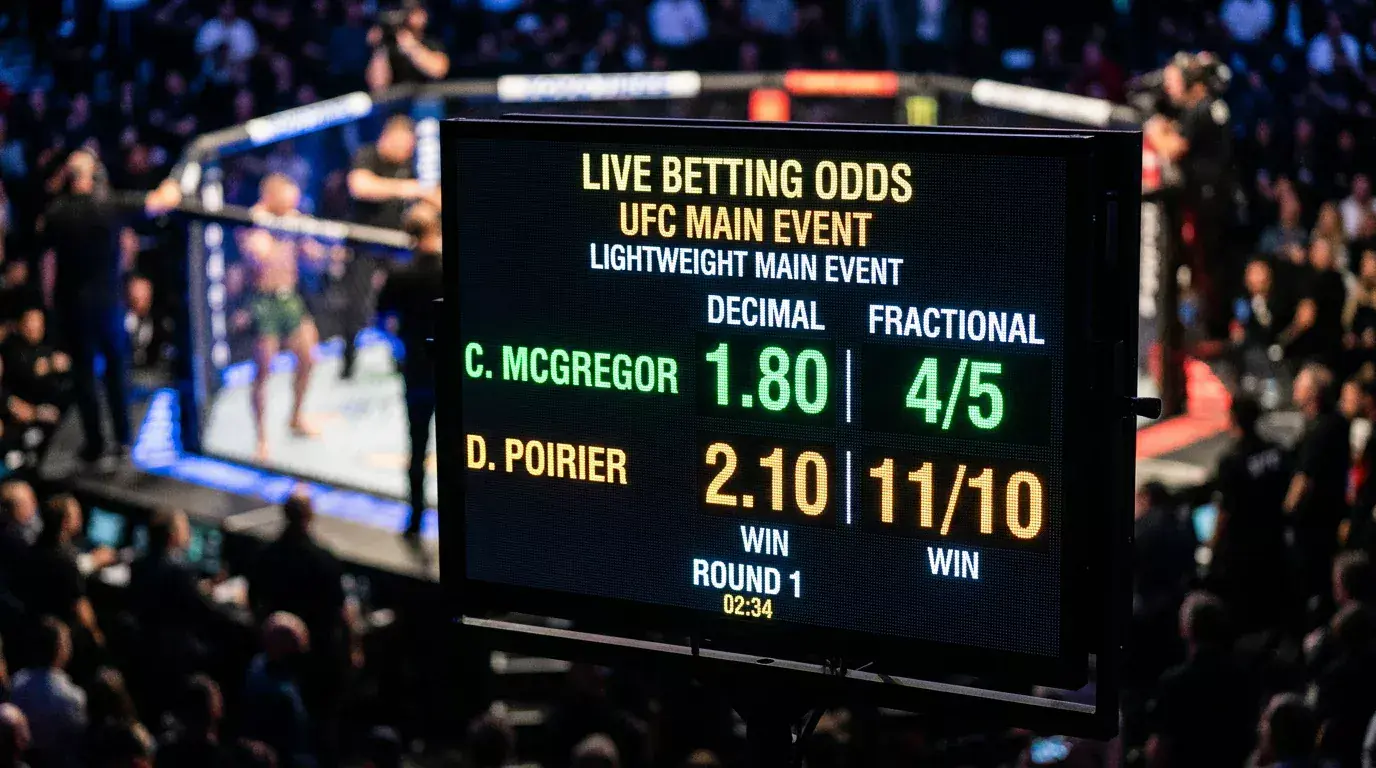
The format your odds arrive in is not decoration — it changes how quickly you can calculate a payout, how intuitively you read a favourite’s price, and whether you spot value or scroll straight past it. Decimal odds hand you a clean multiplication: stake times price equals total return. Fractional odds, the format baked into UK bookmaker DNA since the days of the racecourse ring, express profit relative to stake and feel more natural on short-priced favourites like 1/3 or 2/7. I have watched sharp MMA punters lose seconds on fight night fumbling between formats, and in live markets those seconds cost money.
How Decimal Odds Work in Practice
I remember the first time decimal odds clicked for me. A mate asked what 1.83 meant on a UFC main event favourite, and I told him: multiply your tenner by 1.83 and you get back exactly £18.30 — stake included. That single sentence covers the entire mechanic. No separating profit from return, no mental gymnastics. Your total payout sits right there in the number.
The formula is dead simple. Total return = stake x decimal odds. Profit = stake x (decimal odds – 1). A £25 bet at 2.40 returns £60 total, of which £35 is profit. The beauty is that this works identically whether the price is 1.10 or 15.00 — the maths never changes shape. For MMA markets where you might be toggling between a moneyline, an over/under, and a method-of-victory line within seconds, that consistency matters more than most people realise.
Decimal format also makes implied probability transparent. Divide 1 by the decimal price: 1 / 1.83 = 0.546, or roughly a 54.6% implied chance. When 8% of UK adults participate in online sports betting, and a significant chunk of those are newer to MMA wagering, this directness removes a barrier. You do not need to remember a conversion trick. The number tells you the probability estimate the bookmaker has baked into the price, the margin notwithstanding.
Where decimal really shines is on underdog and prop markets. A fighter priced at 4.50 instantly communicates that the book thinks they win roughly one in four-and-a-half times. Try doing that mental conversion from 7/2 while a between-round window is closing.
The Fractional Format and Its Roots
Walk into any high-street bookmaker in the UK and the screens still default to fractional. There is a reason for that, and it is not nostalgia. Fractional odds express how much profit you make relative to your stake. At 5/1, every pound staked earns five pounds of profit if the bet lands. At 1/4, you need to risk four pounds to earn one pound back. The stake is always separate from the return in this format, which is why old-school punters call the short-priced favourite end of the market “odds on” — you are laying more than you stand to win.
For MMA favourites, fractional has an ergonomic edge I have come to appreciate. When a dominant champion is priced at 1/5, the fraction immediately signals the relationship: risk five to win one. The decimal equivalent, 1.20, communicates the same information but requires an extra subtraction step to isolate the profit. On heavily juiced lines — the kind you see on championship rematches where one fighter has already won convincingly — fractional makes the cost of backing a short favourite feel more concrete.
The format also carries cultural weight. UK bookmakers built their interfaces, their promotional language, and their customer support scripts around fractions. When a customer service agent says a market has moved from 6/4 to 5/4, any punter who grew up with Saturday afternoon accumulators understands the shift instinctively. That institutional memory runs deep in British betting, even as the customer base tilts younger and more internationally influenced.
Conversion Shortcuts That Save You Time
You do not need a calculator for the most common conversions. The core rule is this: decimal odds = (numerator / denominator) + 1. So 5/2 becomes (5 / 2) + 1 = 3.50. Going the other way, take the decimal, subtract 1, then express the result as a fraction: 2.75 minus 1 is 1.75, which is 7/4.
A handful of anchor points cover most UFC lines you will encounter. Evens is 2.00 decimal, 1/1 fractional. The classic short favourite at 1/2 fractional is 1.50 decimal. A moderate underdog at 3/1 is 4.00. And that heavily backed champion at 1/4 translates to 1.25. Memorise these four pairs and you can estimate anything in between by interpolation rather than calculation.
One trick I use on fight night: if the fractional odds look awkward — say 11/8 or 13/5 — I convert to decimal on the spot because the payout multiplication is faster. But if I am scanning a full card of favourites priced between 1/3 and 4/7, I leave them in fractional because the profit-to-risk ratio reads more clearly in that range. The point is not loyalty to one format. It is fluency in both, deployed where each one saves you time.
Matching the Format to the Bet Type
After nine years of pricing fights in my head, I have landed on a simple rule: use decimal for anything where you need to multiply quickly, and fractional for anything where you need to feel the risk-reward ratio at a glance.
Accumulators and parlays are decimal territory. When you are stacking four or five moneyline picks across a card, multiplying 1.65 x 2.10 x 1.40 x 3.20 is straightforward. Trying to compound 13/20 x 11/10 x 2/5 x 11/5 without a calculator is a recipe for error. The same goes for UFC bet types like over/under rounds or method-of-victory markets, where you want to compare two or three prices side by side and spot which one offers the best return per unit risked. Decimal lets you rank prices instantly: 2.40 beats 2.25 beats 2.10. No fraction simplification required.
Fractional earns its keep on short favourites and in-play markets where the price range is tight. If you are backing a dominant grappler at 1/6, the fractional format spells out the grim reality: you are risking six units to win one. The decimal equivalent, 1.17, just looks like a small number. With a UFC fanbase that includes roughly 700 million people globally and the UK ranking among the top markets for interest, plenty of newer bettors encounter these short-priced champions on their first card. Fractional communicates the cost more viscerally.
Props and specials sit in a grey zone. I lean decimal because prop lines tend to fall in the 3.00-to-12.00 range, where the implied probability conversion is more useful than knowing the profit ratio. But this is personal workflow, not scripture.
Default Odds Formats Across UK Bookmakers
Most UK-licensed sportsbooks default to fractional when you first open an account, then let you toggle to decimal in settings. A few — particularly those with European roots — default to decimal. The toggle is usually buried in a preferences or settings menu rather than displayed prominently on the betslip, which means a surprising number of casual bettors never change it.
What matters more than the default is whether the platform remembers your preference across sessions and across devices. I have tested accounts where the desktop remembered decimal but the mobile app reset to fractional every login. If you are serious about MMA wagering, check this on your first session and set it once. Switching mid-card introduces cognitive friction you do not need when a between-round market is about to close.
The broader trend is unmistakable: decimal adoption is growing, particularly among younger UK bettors who arrived via international streams, social media tipsters, and MMA communities where American-decimal hybrid formats dominate the conversation. The fractional default will likely persist for years in the UK — tradition runs deep — but the functional gap between formats is closing as every major operator now supports both with a single tap.
Why do UK bookmakers default to fractional odds for football but decimal for UFC?
Football betting culture in the UK grew up with fractional odds at the racecourse and in high-street shops, so operators kept fractional as the default to match customer expectations. UFC attracted a younger, more internationally connected audience that already uses decimal — so many operators either auto-detect the sport or allow per-market format switching. In practice, the default is a legacy setting, and you can override it in your account preferences on any UKGC-licensed site.
How do I convert 2.20 decimal odds into fractional?
Subtract 1 from the decimal price to get the profit per unit staked: 2.20 – 1 = 1.20. Express that as a fraction: 1.20 is 6/5. So decimal 2.20 equals fractional 6/5. A quick sanity check: at 6/5, a five-pound stake wins six pounds profit, returning eleven pounds total. Multiply 5 x 2.20 and you get the same eleven pounds.
Written by the editors at mma Betting Websites.